Thursday, May 5, 2011

Nursing by Leg Power

Here's the next post from Rebecca...

As I dig deeper into the agency’s history I am finding more and more information on the partnership between the VNAB and Simmons College. The two started cooperating in 1912 to offer academic coursework specifically for Public Health nurses. Simmons’ Department of Public Health Nursing was established in 1916 under the direction of Anne Hervey Strong, and in 1918 a full-fledged School of Public Health Nursing was created and run jointly by the Instructive District Nurse Association (known today as the VNA of Boston) and Simmons College.

This week, I would once again like to share something I found in the Simmons archive with much appreciation to an author from the past. The article, entitled Nursing by Leg Power (see below - apologies that it's a bit hard to read; if you click on the graphic, it will open in another window and may be easier to read) by Dorothy Deming, was published in November of 1929 in a journal titled The Survey. The Survey started as an in-house publication of the New York Charity Organization Society in 1902 and under the editorial direction of Paul U. Kellogg it became the “most eloquent and revered voice of the social justice wing of the twentieth-century American reform movement“until it ceased publication in 1952. (See note.)

I immediately liked the article as it is quite humorous. The author also artfully weaves in a wealth of information about what a Public Health Nurse is, what she does, how she is trained and the nuts and bolts of her vocation. Again, it is interesting to note the similarities with today’s visiting nurse experience…the challenge of defining exactly what a visiting nurse is, the diversity of cases seen, the complications of reimbursement, the extent to which education needs to be tailored for the visiting nurse and of course the uniform… just kidding! (I’m not so sure about the illustration comparing a visiting nurse to a mother monkey… but I guess in 1929, evolution was still a somewhat radical concept!)...


Note:
From a review of the book “Paul U. Kellogg and the Survey: Voices for Social Welfare and Social Justice by Clarke A. Chambers, University of Minnesota Press, 1971, review by Robert H. Bremner http://collections.mnhs.org/MNHistoryMagazine/articles/43/v43i02p072-081.pdf

Friday, April 29, 2011

VNA of Boston loses a dear friend


The Visiting Nurse Association of Boston said farewell to Peggy Buckley this week.  Here, from the Boston Globe, is her obituary.  This will give you a good idea why she was so special... and why we'll miss her.
Traits that made her an accomplished social worker and a friend to whom everyone turned were apparent when Peggy Buckley was growing up in New York City.
“She had enormous insights into people and knew how to provide comfort and assurance to them, even as a young child,’’ said her older sister, Marlene of Bronxville, N.Y. “She would feel bad if another child was picked on at school. It bothered her. She always had an unusual sensitivity to the feelings of others when they felt hurt or wounded.’’
During about 40 years as a social worker in Boston, mostly in Charlestown and Dorchester, Ms. Buckley went beyond counseling clients. She worked to ease racial tensions during school desegregation and to reduce the number of lead poisoning cases among children.
Ms. Buckley, who since being diagnosed with cancer three months ago used her dwindling ability to speak to ask friends how they were coping and to give thanks for their care, died Monday in her Jamaica Plain home. She was 67.
“Over the past 20 years, she has helped thousands of seriously deprived and impaired clients reach their highest level of function,’’ Dr. Bennett Gurian, a former colleague of Ms. Buckley’s at Bowdoin Street Health Center in Dorchester, wrote in a nomination letter for the Bernice K. Snyder Award for excellence in social work, which she received in 2001. He added that “my life, as the only psychiatrist in this mammoth agency, has been made so much better by having Peggy Buckley as my collaborator.’’
As a clinician, Ms. Buckley “was always championing the underdog,’’ said her friend Tish Allen of Jamaica Plain.
Ms. Buckley also made time to champion the passions of her friends, as deft a social worker in private life as she was professionally.
“She was the most fantastic listener I have ever known,’’ Allen said. “You would have that feeling when you left of, ‘Oh, my God, I spoke 90 percent of the time.’ She would support you and make you the hero in her stories.’’
Ann Anderson of Jamaica Plain, whose friendship dates to when she and Ms. Buckley both lived in Charlestown, said: “Everyone felt free to tell her anything about anything. I think the single most striking thing about her, which is why she had so many friends, is that she was a wonderful listener.’’
That was also true when Ms. Buckley was a child, her sister said.  Margaret Buckley, whose father was from County Kerry in Ireland and whose mother was from County Laois, was named for her maternal grandmother and grew up in the Bronx. While attending parochial school, she encountered classmates who had been wronged.
“She would come home and be very upset, and she would cry,’’ her sister said, “and my mother would suggest ways to handle it and how to approach the child and make the child feel better.’’
Ms. Buckley graduated in 1961 from St. Nicholas of Tolentine High School in the Bronx and went to the College of New Rochelle in New York, from which she graduated in 1965 with a bachelor’s degree in sociology.  She became a volunteer through VISTA, Volunteers in Service to America, a national organization formed that year, and worked first in Richmond, Calif., developing youth educational and recreational programs.  Then she moved to Chicago, where through the Hull House Association she worked with low-income adolescents, principally Native Americans and teens who had moved with their families from poor Appalachian regions.
“She was not in an office,’’ said her former husband, Zachary Klein of Jamaica Plain, who met Ms. Buckley in Uptown, a neighborhood on Chicago’s north side. “She worked with gang members who lived in the neighborhood we both lived in at the time.’’
Ms. Buckley, he said, “was very, very good at picking out leaders of kids and would work with the leaders in order to actually sway more than just that one kid’’ away from gang activities and back into school or toward programs that helped them earn general equivalency diplomas.
“She was always someone who believed in social work and that clinical social work was absolutely imperative in society, especially for poor people who couldn’t afford the services that the middle class got,’’ Klein said.
The two married in 1970 and divorced after moving to Charlestown, where Ms. Buckley was executive director of the Charlestown Community Center. Along with coordinating counseling, education, and recreation programs, she turned the center into a place where those with opposing opinions of court-ordered busing knew their views would be heard.
At home, Ms. Buckley and Klein voluntarily had their son bused to a magnet school in Roxbury, where he studied in a diverse student population.
“Peggy worked against racism, but she also understood there was a lot more going on here,’’ said Anderson, who lived in Charlestown at the time. “It was about people who had no control over their lives, except for their kids, and suddenly they didn’t have control over that, either. The community center was a place where it was safe to voice different opinions, but where there was a firm line drawn against violence.’’
Ms. Buckley received a master’s in social work from Boston University in 1978, the year she began working at Bowdoin Street Health Center in Dorchester. Along with counseling clients, she played a key role in a collaborative that helped reduce lead paint poisoning cases among neighborhood children.  While at the center, she received a master’s in public health from BU in 1994, and “was very supportive to all the staff and helpful on a personal level,’’ said Kathy Cook, a pediatric nurse practitioner at the center. “If there was trouble with a shooting in the neighborhood and the family came in, she would not only console them, but she would help the staff deal with the trauma. She really did multiple roles.’’
Ms. Buckley, who spent the past several years working for the Visiting Nurse Association of Boston and Affiliates, vacationed with friends annually on Cape Cod or Martha’s Vineyard, always insisting they rent houses strategically positioned to be buffeted by restorative cool breezes.
She loved Christmas because the holiday brought families together, said her son, Matthew Klein of Brooklyn, N.Y., and took care to tell the story behind each ornament she placed on the tree.
“Materially, she was the opposite of self-indulgent,’’ he said, with one notable exception. She had a sweet tooth that was legend among family and friends.  Sometimes when mother and son went out on errands, “we would stop at a corner store,’’ he said, “and she would let me get one treat, and she would get two treats.  “She would say it was because her stomach was bigger.’’
Bryan Marquard can be reached at bmarquard@globe.com.

Tuesday, April 26, 2011

Twentieth Century Follies of the Public Health Nurse


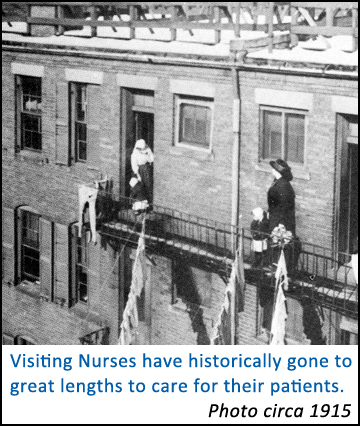
Our clinicians may not have to climb fire escapes every single day, but they still do go to great lengths to care for their patients.

Here's part two in the series from Rebecca...

While at the Simmons College archives looking for material on the relationship between our early organization (the Instructive District Nurses Association or IDNA) and The School of Public Health Nursing at Simmons, we found an absolute treasure….a 15 page book from November 1920 titled the “Twentieth Century Follies of the Public Health Nurse” filled with humorous and satirical poems, stories and cartoons written by the students and staff based on their experiences as visiting nurses.


The School of Public Health Nursing was founded in 1918 as a joint effort between the IDNA and Simmons College in order to provide college level training that was specific to the needs of public health, visiting or community nurses – one of the first programs in the country to do so. Up to this point, most nursing training took place in hospitals and the teaching was focused on issues faced by hospital patients and the nursing skills required for this population, as well as the unique needs of the particular hospital. The new School of Public Health Nursing was chronically short of funds in its early years and frequently appealed for support from both private and public sources. The students and staff created this book to help raise money for the school.

I will periodically share some of the gems from this collection – with GREAT gratitude to the original authors, who are unfortunately anonymous. I hope you enjoy these fun entries, many of which still strike a chord today!

An Everyday Occurrence

A call came into our office today
To visit a patient right away.
The flight was not known but you may know
‘Twas up to the roof where the nurse must go.

She finds the door and gently raps,
Gently, I say, for she’s near collapse.
With scarce any breath she asks the name
And would you believe it – it wasn’t the same.

She looks at her book to see if she’s right,
Where it is written in back and white.
She must call the doctor, and runs for a phone,
His message she takes with an inward groan.
“Did I say Blank Street? Oh, I meant Blank Alley,”
And out again we see her sally.
At last she reaches the highest flight
And wonders if the end is in sight.

She opens the door and walks into the room
She is greeted with tears as if some doom
Were there to stay, “Where is the patient?” we hear her call,
(Now wouldn’t this answer make you bawl?)
“She’s just gone to the hospital.”

Monday, April 18, 2011

History of the VNAB: The People, The Times and How We Became Who We Are


VNA CEO readers know that we're celebrating our 125th continuous year as the very first Visiting Nurse Association in the United States.  Thank you for your comments, questions and emails asking about our origins and storied history.  I'm happy to announce that, starting today, our very own Rebecca Dempster, a talented writer and our education program coordinator, will begin the process of formally telling our story. 

Here's the beginning...

My name is Rebecca Dempster and I am the Education Program Coordinator at the Visiting Nurse Association of Boston (VNAB). Over the next few months I will be a contributing writer chronicling the agency’s history and how it has been such an integral part of our community’s rich history. We are celebrating our 125th year in business, 1886 – 2011. Wow! That just goes to show what a great idea Miss Phebe G. Adam and Miss Abbie C. Howes had in 1885 and what an essential resource a visiting nurse is – then and now!

As we celebrate this anniversary we find ourselves gazing back over the decades and centuries. We dig out the boxes of old photos and see the serious and determined faces of our predecessors from the 19th century , the spiffy and energetic nurses of the mid-20th century and our coworkers at get-togethers from a the past 10 or 20 years. We revisit the bound volumes of annual reports sitting on an obscure shelf gathering dust, intending to spend a couple of minutes casually flipping through the pages, only to emerge an hour later having been drawn into the stories of the dedicated and passionate ladies who first envisioned visiting nurses in Boston and with vivid images of the valiant efforts of our first nurses.

This year, in addition to celebrating our 125th anniversary, we are also celebrating the re-establishment of our relationship with the School of Nursing at Simmons College – a relationship that was first formed in the early 1900s. We are working on exhibits displaying our rich history, so my colleagues and I headed out to the archives at Boston University and Simmons College to delve a little deeper into our past and to see what we could dig up in terms of original letters, articles and photos relating to important events in our history.


On a blustery day in March we were ushered into the Howard Gotlieb Archival Research Center at BU by Diane Gallaher, Nursing History and University Archivist. Diane issued each of us a pair of white cotton gloves, asked us to place all our bags, coats, sweaters, and scarves in a locked closet and to leave our IDs at the front desk. Then the 35 boxes of VNAB archival material were rolled into the hushed room. It was totally overwhelming and I couldn’t imagine how we were going to cover all this material. I randomly picked up Box 1 and started sorting through the collection of letters, notebooks and articles inside. While my colleagues efficiently absorbed the contents of several boxes, I sat there feeling pretty useless as I tried to decipher the spidery handwriting of Elizabeth Cordner, tried to understand what the Instructive District Nurses Association was, marveled at the extensive correspondence regarding fundraising and networking, and wondered who Mrs. Codman and her brother Ingersoll Bowdtich were.

Back at the office the next day I told anyone who would listen about how amazing these people were, and the amount of work that went into founding the VNAB and the energy and dedication that shone through all the activity revealed in that box of documents– and most of all how reading these documents brought to life what were otherwise just names on a page. I think I was starting to drive everyone crazy sending out long “Did you know….!” and “ Can you believe….!” e-mails, so the company has kindly offered me an outlet for my enthusiasm in the form of this blog and hopefully I will stop clogging in-boxes with my latest revelation!


As I read the original documents and think about our history, one of the things that drives me is a curiosity about the people – who they really were, what motivated them, what influences, personal and social, led them to do what they did. What were their strengths and weaknesses, how did they manage the work, did they like each other, was there friction, what were their family and social connections, did they do a good job? I also find myself curious about the social and political environment in which we operated and how that influenced the steps we took as an organization and perhaps how that differed from the track community health took in England. It is also interesting to see some of the same themes and concerns that we still talk about today: poverty, lack of education, infectious disease, chronic disease, tracking outcomes and finding money to keep the doors open. Does this mean that we have not succeeded in solving the public health problems we were facing 125 years ago and that we are still fighting the same battles? Or is it just the human condition, and the role of people in the “helping” professions is, and will forever be, to fight human tendencies that compromise our personal health and that of our communities and to support and facilitate change in behavior, provide opportunity, form healthy communities, and educate?

Lastly, just a couple of disclaimers before I finish up this week’s entry. I am not a historian and due to my limited time and expertise I am certain I will miss many events, that many of my thoughts will be naïve, and that I may even be downright wrong about some things. My guide is curiosity and my goals are to share some of the original material which would otherwise remain hidden away in boxes in archival collections, to put the path of our history into the context of what was happening in the world around us, and to try to bring to life the women…and even a few men, who played a part in establishing and the continuation of our venerable organization. Hopefully, in sharing what I find interesting and what I am curious about I will be able to create a kernel of interest in others. I also hope that readers will add their own comments, knowledge and reaction to the topics covered in the blog – and also perhaps suggest topics for investigation if you see a gap or are curious about something that an archival resource or a bit of historical research might shed some light on…or even to do some of investigating yourselves and share what you find! There are numerous on-line resources that provide Finding Aides for original material kept at repositories in Boston…the Massachusetts Historical Society, Boston Public Library, the Harvard Archives, Boston Atheneum – not to mention what we might find just scanning the VNAB bookshelves and looking in closets! Searching Google Books and the Boston Globe Archives can also be very informative.

Check back each week as I unearth and dive into the rich, sometimes ironic, but always interesting history of the VNAB.

Thursday, March 31, 2011

Face-to-face requirements set to kick in tomorrow

This from the Visiting Nurse Associations of America.  In short... bad news for home care agencies and the most vulnerable patients they serve.
VNAA Disappointed with CMS Decision and Pledges to Continue Improving Face-to-Face Requirements.

(Washington, DC) – March 31, 2011 – Jonathan Blum, Center for Medicare Management Director, notified the Visiting Nurse Associations of America (VNAA) and other national organizations via phone today that the Centers for Medicare and Medicaid Services (CMS) will stick with full enforcement of the face-to-face encounter provision effective April 1.

During the call to Kathleen Sheehan, Vice President of Public Policy for the VNAA, Blum said that CMS felt it was time to move forward with full implementation and that it would carefully monitor any problems that patients might face with access. While the face-to-face provision was put into effect on January 1, 2011, a grace period of 90 days had been granted by CMS before financial penalties for noncompliance would be levied.

The phone call was made to Sheehan in her role as the convener of a coalition of national organizations that have worked with CMS over the past couple of months to iron-out expected problems with implementation. Members of the coalition, which includes AARP, the American Hospital Association, the Catholic Healthcare Association, the American Medical Association, American Case Management Association, the Society of Hospital Medicine and the National Association for Home Health and Hospice had met with Jonathan Blum and CMS on several occasions to address implementation issues and asked that the grace period on financial penalties be extended for another 90 days to provide time to educate physicians about their new responsibilities and make system changes. The coalition's effort was unprecedented in terms of bringing together such a wide spectrum of beneficiary and provider groups behind regulations that impacts payment for home health and hospice services.

“We are deeply disappointed that more time was not provided as there was a strong consensus among diverse groups that it takes about 6 months for an educational and system change of this magnitude," said Andy Carter, VNAA President and CEO. "Our nonprofit members are most likely to take the risk of serving patients who may not have a primary care physician and may not be able to get the documentation done within the timeframe. Our goal now is to work with VNAA members and others to document and report the problems implementing this provision that will most certainly delay or limit access to care for some patients. ”

Carter also noted that while VNAA members and the Face-to-Face Coalition were not able to win a further grace period, they have worked hard to convince CMS to make the implementation less onerous and that they will continue to do so.

For more information, visit the VNAA's Face-to-Face Webpage http://vnaa.co/F2Fhelp.

Wednesday, March 30, 2011

Co-pays for home care

The Massachusetts Home Care Alliance hosted an event for members of the Massachusetts elected delegation and their staffs. I had an opportunity to address them. Here are my remarks:


Thank you for the coming to our luncheon today and for this opportunity to speak to you about home health care.

I am Rey Spadoni, the President of the Visiting Nurse Association of Boston... an organization that is celebrating, this year, our 125th anniversary as the very first home health care provider in the United States. In the late 1800s, a group of bold and visionary women took note of the unmet needs of the most vulnerable members of the Boston area community... the individuals who were falling through the cracks of the then emerging network of infirmaries, clinics and hospitals. We are most pleased to be able to say that their vision is alive and well in our organization a century plus later as we continue to fill in those gaps for those among us who are, in fact, the most vulnerable.

I begin my comments by expressing our gratitude for all that you, your colleagues and our entire elected delegation from Massachusetts have already done for these members of our community and the agencies such as the VNA of Boston who care for them. Thank you for making us in this room the envy of our colleagues from 49 other states.

I also want to acknowledge that in my almost 30 years of working in the health care industry, I've never seen it like this before. It's a time of great change... and great stress.

There's no doubt that every one of us in this room believes in the importance of ensuring high quality home care services. Services that are good, dependable and consistent. There's also little doubt that all here believe that it's important to ensure access for every single person in our community.... whether they are people of means or people who struggle. But now, the third leg of the stool, the cost of health care, is front and center. Reigning in the escalating costs of health care has emerged as critical to not only preserving the health care system, but also in helping to address the larger economic problems and even long-term fiscal viability of our nation.

We certainly get that.

In the years I've worked in this industry, I have come into this building... sometimes talking about the issues of the acute care hospital industry, sometimes post-acute hospitals and on one occasion, the needs of federally qualified community health centers. On each occasion, I offered perspectives... perspectives you are all very familiar with... that each segment of the industry I represented at that time had unique needs and that we were part of the solution, not part of the problem. The points I made were legitimate.

But as I come here today to talk about organizations such as the VNA of Boston, I would like to point out two important differences between home care and the other parts of this industry.

First, we keep people out of those institutions. We keep people where they want to be most of all... in their own homes... living as independently as they are able... keeping families together... and providing dignity.

In the home care industry, we don't talk about the fixed costs associated with brick and mortar construction projects and we don't need to recoup R&D dollars associated with new and costly diagnostic technologies. We keep people out of those settings and in their own homes.

The second point relates to the fact that patients are being discharged more quickly and sicker than ever before from the hospital. Across the United States, 29% of all home care patients are readmitted to the hospital because their medical condition has deteriorated. At the VNA of Boston, that figure is 25%. It's 25% because we invest in training for our staff, focus on medication reconciliation, and deploy remote technologies into homes so that we know right away when a patient's condition requires immediate follow-up care. That 4% difference spread to larger populations... that is... paying for home care services instead of hospital readmissions, is a critical component of cutting overall costs in the health care industry. It is also a vital component of the emerging Accountable Care Organization movement.

If you or your colleagues have never been on a home care visit, I would like to invite you to accompany one of our skilled nurses or therapists on one. I guarantee that it will be eye opening and that you will enjoy it.

If you have not been on a home visit, I would like to tell you about one I recently made.

Pat, a 20-year home health veteran nurse, and I traveled together out to perform an admission of a 59 year old man named Richard. Richard lives alone in a large apartment complex in Quincy, Massachusetts. I learned upon arriving in his small three room home that Richard was honorably discharged from active service in Viet Nam when he sustained a nearly life-ending injury serving this country. The reason for our visit was due to a recent orthopedic related hospitalization, but the home care admission process requires a very thorough examination of a whole variety of health related topics... and thank goodness for that for Richard.

I couldn't help but notice as we entered his apartment that there was visible evidence of great patriotism everywhere, as well as signs of a hobby constructing intricate small scale models of 18th century ships. I subsequently learned that this was a long past hobby due to the advancing arthritis in Richard's hands. I also could not help but notice the multitude of prescription bottles on the coffee table in front of us. Because of Richard's arthritis, he can't contend with child-proof caps and so all bottles were open, with several tipped over, leaving a multicolored array of pills before us.

As I said, it's a good thing that the home health admission process calls for a thorough evaluation on a number of issues because it was during that process that Pat discovered a significant discrepancy between the medications listed on his hospital discharge summary and the one his primary care doctor had given him just a few months earlier. When questioned, Richard appeared to be confused over exactly which set of prescriptions he should be following. Rather than spending 45 minutes in his home, Pat and I were there for nearly two hours. During that time, Pat contacted the hospital staff first and then the nurse practitioner at the medical practice where his doctor works. She sorted through the complex set of drugs, focusing mostly on the ones he takes for diabetes, and ultimately came up with not only a game plan but also secured an appointment for him very next morning with his physician.

As she was on the phone dealing with this, I learned more about Richard. I learned about the reasons he is now homebound, I learned about the challenges he faces... including financial... and I saw firsthand just how much he trusts the VNA.

As we walked out of his apartment, Pat told me that it was likely that Richard would have experienced a significant medical problem, diabetes related, within days caused by the medication confusion. That problem would have most assuredly resulted in an ambulance ride to the emergency room and a 2 or 3 day hospitalization. That trauma, those additional expenses, were all avoided. Matter of factly, Pat told me "it happens all the time" as we drove away.

It happens all the time.

And so, I wanted to tell you about a proposal to levy $150 co-payments per 60 day episode of care upon patients such as Richard. MEDPAC has suggested the institution of these co-pays as a way to control Medicare spending.

When our nurses, who care for patients in the poorest neighborhoods of Boston, hear about this suggestion... they roll their eyes and tell us that most... most... of their patients will not pay them. They will prioritize paying for their prescriptions, their rent and food before they will pay for home care services. For most of our patients, age 80 and above, they are already spending 30% of their limited incomes on uncovered medical care.

At the VNA of Boston, we support initiatives that foster a greater degree of engagement and participation in health care decisions and costs... which co-pays are designed to do. But we have evidence that they are not the answer in home health care... having been tried before and eliminated in the 1970s when they were found to increase inpatient spending.

A recent "New England Journal of Medicine" article profiled 900,000 Medicare Advantage beneficiaries and the impact of new ambulatory visit co-pays. They found that for every $7,000 saved through the adoption of the co-pays, inpatient costs increased $24,000. Patients avoided the ambulatory visits, their health status had worsened... and their care cost our system more. Not only do co-pays not work for this population, they backfire.

We need your active help in preventing this mistake from happening once again.

Co-payments are short-sighted. They are ineffective. And unfortunately, they are cruel.

Please join in our fight to prevent them.

Thank you...

Sunday, March 27, 2011

The Cherry Blossom Chill

This weekend marks a most welcome start to the annual Cherry Blossom Festival in Washington, DC. This yearly rite ushers in expectations of warmer weather, sunnier skies and bursting beauty to offset the declining frost and grays of the season just ended. We sense great hope, we anticipate, and we are optimistic.

But as I peck this post onto the onscreen keyboard of my iPad (yes, I'm in Airplane Mode; I'll upload when we land), I wonder about the snow that is now falling in the city of blossoms. Our pilot just instructed us to expect a choppy ride as we descend into wintry conditions.

This weekend also marks our annual trek to Capitol city with our National Association for Home Care & Hospice colleagues to plead our case to elected legislators and the surrounding multitude of policy makers, regulators and analysts.

I recall last year at this time...

Rumors of forthcoming cuts to home health care reimbursement prevailed and so we readied strategies of pointing to evidence that home care is the solution... not the problem... in terms of escalating health care expenditures. On paper, we looked good. We were hopeful and we were optimistic. And we had good reason to be. Everyone who met us on The Hill told us they were on our side. They described themselves as The Good Guys and our hearts warmed a little to be surrounded by so many good guys. We clapped and cheered at luncheons and patted each other on the back in front of cheese trays and regal china.

But then the cuts did come...

And for organizations such as the VNA of Boston, agencies who don't skim off the topmost layer of best-paying customer cream, we reeled. We planned for difficult days and we hunkered down and readied for the storm. But would the storm linger... or pass by quickly?

That is the question as we prepare to descend into the wintry conditions of the "rebasing" and "copayment" talk now in DC. Talk that portends of more cuts.

And I fully anticipate I'll meet up with The Good Guys once again. They will tell us we are preaching to a choir and that our fight is with others. But our message this time is to enlist them in this fight, to request their entry into our fray.

The most vulnerable among us need that. The ones who are homebound... and who rely upon us to be their voice... deserve that.

Otherwise, it will all... once again... be merely frost upon a cherry blossom spring.


- Posted via BlogPress/iPad

Friday, March 4, 2011

A Day on the Hill...

This time, it was on Beacon Hill, the location of the Massachusetts Capitol and home base for the Commonwealth's government officials.

photo.jpg

I, and two of my VNA of Boston colleagues, attended a reception hosted by our local association, the Massachusetts Home Care Alliance.  Our positions:

  • Allow trained and certified home health aides to administer certain medications in the home.
  • Change how specific home health services are reimbursed, including paying for telehealth.
  • Establish a more equitable rate of payment of home care agencies providing continuous skilled nursing care to children.
  • And most importantly, create reasonable reimbursement rates for services provided to Medicaid recipients.

photo2.JPG

Pictured: Maria Dunn, RN,, clinical manager, and Janice Sullivan, vice president of external affairs.


From our meetings with representatives, it's clear that the process to develop a comprehensive and unified health care cost containment bill will be long and contentious.  Despite Governor Patrick's proposals, it's likely he will have a long road ahead of him to push through the reforms that his bill contains.  Some members of the legislature perceive that the Governor seeks a quick victory on this topic to aid in this emerging national role in pushing the President's own health reform law across the country.  And not everyone's willing to play it seems.

Then again, no one predicted that the Massachusetts legislature would give then Governor Romney a health care victory he could tout for his own presidential ambitions.  The Democrat controlled legislature did just that for the Republican governor... so, a decisive win for Governor Patrick could certainly still be in the cards.

Door to door scams still exist

I was just visited at my home by a pleasant young man asking if he could see a copy of my most recent gas and electric bill.  He said he was here in partnership with my energy companies.  In fact, he noted, his company, "Just Energy", was doing this service for the energy companies' customers by switching the "underlying supplier" of the energy to a cheaper and greener source.

When I told him I was uncomfortable with giving this information to a stranger, he asked me whether I was uncomfortable with saving money.  Uncomfortable with saving the planet.

Uhm... red alert.

A google search pointed out quite a bit about "Just Energy".

To which I reply, just be careful